Just Passing Through: The Century-Long Sleepover of American Military Bases
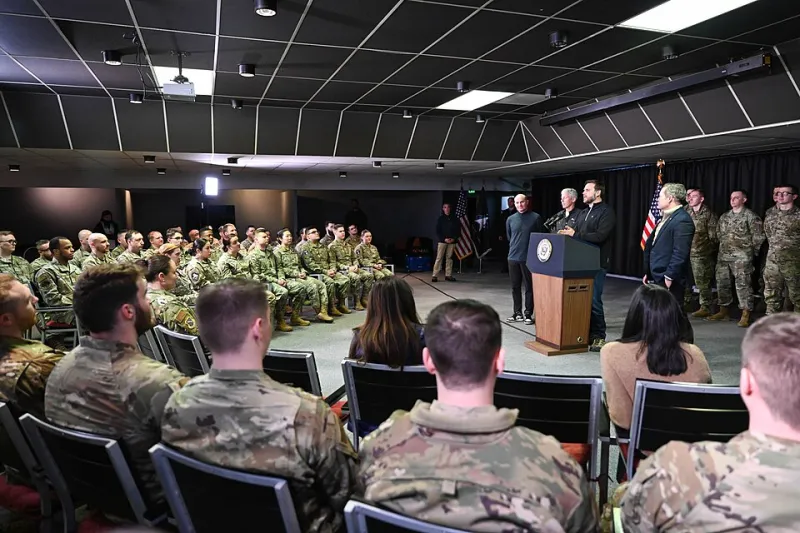
Photo: U.S. Space Force photo by Staff Sgt. Jaime Sanchez, Public domain, via Wikimedia Commons
Imagine you invite a houseguest to crash on your couch for a weekend. They show up with a steamer trunk, reconfigure your kitchen, install a satellite dish on your roof, and are still there forty years later explaining that they're "just wrapping things up." Congratulations — you now have a rough understanding of how American military basing policy works.
The United States currently operates somewhere between 750 and 800 military installations in foreign countries, depending on how generously you define "installation" and how motivated the Pentagon is feeling when it files its paperwork. That number is, by any honest accounting, more than every other nation on Earth combined. And yet, if you ask the relevant officials, almost every single one of these bases exists in a state of perpetual impermanence — provisional, flexible, subject to review, definitely not permanent. Any day now, really.
The Art of the Temporary Arrangement
The lifecycle of a "temporary" American military base follows a remarkably consistent script. Act One: a crisis, a conflict, or a strategic opportunity emerges. A Status of Forces Agreement (SOFA) is negotiated — usually in a hurry, usually with a government that needs something from Washington, and usually with language vague enough to drive an Abrams tank through. The base opens with a ribbon-cutting nobody photographs.
Act Two: the immediate crisis fades. The base does not. Logistics infrastructure has been built. Contractors have been paid. Careers have been built around the installation's continued existence. A constellation of economic dependencies has formed in the surrounding community — because nothing says "temporary" like a Subway franchise opening just outside the perimeter fence.
Act Three: local opposition emerges. Protests flare. Politicians make noise. A renegotiation is announced with great fanfare. The base is slightly reorganized, possibly renamed, and perhaps a few hundred personnel are quietly redeployed to a newer, shinier installation three countries over. The original base continues operating.
Repeat indefinitely.
Okinawa: The Gold Standard of Overstaying
If you want to study the form at its most refined, look no further than Okinawa, the small Japanese island that has been hosting American military installations since 1945 — which is to say, since the end of the war that supposedly justified their presence in the first place. Okinawa makes up less than one percent of Japan's total land area and hosts roughly seventy percent of the U.S. military footprint in the country. The math alone should raise an eyebrow.
Decades of protests, multiple formal requests for base consolidation, a 1996 agreement to relocate the contentious Marine Corps Air Station Futenma — all of it has produced movement roughly equivalent to continental drift, and considerably less reliable. Futenma, described by a former U.S. commander as "the most dangerous base in the world" due to its location in a densely populated urban area, is still there. The replacement facility at Henoko has been under contested construction since 1996. The temporary arrangement is now old enough to have grandchildren.
Diego Garcia: When the Locals Become an Inconvenience
For a rather darker case study in the permanence of temporary arrangements, consider Diego Garcia, a British Indian Ocean Territory that the United States has used as a major military hub since the 1970s. The island's indigenous Chagossian population was forcibly removed between 1968 and 1973 to make way for the base — relocated to Mauritius and the Seychelles with minimal compensation and maximum indifference. British courts have repeatedly ruled the expulsion illegal. The United Nations has weighed in. The Chagossians have been fighting for the right to return for half a century.
The base, meanwhile, remains operational, has expanded considerably, and played a central role in both Gulf Wars and the War in Afghanistan. Nothing says "temporary" like displacing an entire people to build it.
The Bureaucratic Perpetual Motion Machine
What keeps these arrangements humming long past their stated expiration dates? A few reliable mechanisms deserve credit.
First, there is the sunk cost architecture. Once the Pentagon has invested billions in runways, fuel depots, command infrastructure, and housing, the institutional pressure to justify that investment by continuing operations becomes nearly irresistible. Closing a base means admitting the money was spent on something finite. The military does not love admitting things are finite.
Second, there is the contractor ecosystem. Every major base supports a web of private contractors — construction firms, logistics companies, food service operators, security providers — whose lobbyists in Washington have a professional interest in keeping the lights on. Defense contractors do not fund congressional campaigns so that bases close.
Third, and perhaps most elegantly, there is the strategic ambiguity gambit. Every base, no matter how obviously permanent, can be described as a "forward operating location," a "cooperative security location," or a "lily pad" — Pentagon jargon for a small installation that implies mobility and impermanence while delivering neither. Language is doing a lot of heavy lifting here.
The Invitation That Never Expires
Host governments, for their part, often find themselves trapped by their own initial enthusiasm. The government that signed the original SOFA may be long gone, replaced by administrations with considerably less interest in American military proximity. But renegotiating or terminating a basing agreement invites enormous diplomatic and economic pressure — aid packages reconsidered, trade deals quietly stalled, strongly worded phone calls from Foggy Bottom.
The Philippines famously evicted American forces from Clark Air Base and Subic Bay Naval Station in 1992, a genuinely rare act of sovereign assertion that required both a volcanic eruption (which helpfully destroyed much of Clark) and a Senate vote so close it had to be broken by the vice president. The U.S. military, naturally, is back — under a new agreement, with new access arrangements, and with the full expectation that this time things will be different.
They will not be different.
A Permanent Impermanence
There is something almost admirable, in a bleak sort of way, about the consistency of the performance. Every new base comes with the same assurances, the same flexible language, the same promises of mutual benefit and respect for sovereignty. And then the Subway opens outside the fence, the contractors arrive, and the base quietly begins its transformation from temporary inconvenience to permanent feature of the landscape.
The United States has been "just passing through" on somebody else's soil for the better part of a century. At some point, the phrase loses its meaning entirely — which may, of course, have been the point all along.