Meet the New Boogeyman, Same as the Old Boogeyman
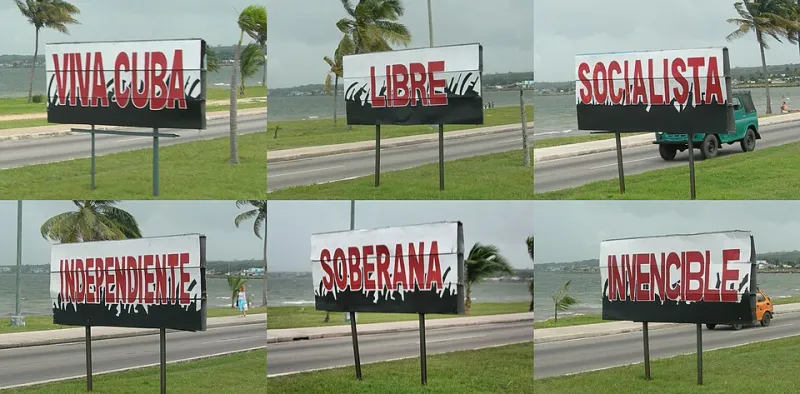
Photo: Jove, Public domain, via Wikimedia Commons
Every generation of American policymakers inherits a gift from their predecessors: a fully operational enemy-manufacturing apparatus, ready to be pointed at whoever needs pointing at. The names change, the maps shift, and the press releases get a fresh coat of paint — but the machinery hums along just fine. Somewhere, a defense contractor is already printing the brochures.
Welcome to the great American tradition of threat recycling — a bipartisan art form so refined, so elegantly self-sustaining, that it barely requires human supervision anymore.
The Original Franchise
Let's start at the beginning, or at least the modern beginning, because empires are allergic to actual beginnings. After World War II, the United States found itself in an enviable and slightly awkward position: it had the world's most powerful military, a booming industrial base, and absolutely no one left to fight. The solution, arrived at with impressive speed, was to identify the Soviet Union as an existential menace of such staggering proportions that the war economy never had to wind down.
This was, strategically speaking, a masterstroke. The USSR was large, nuclear-armed, and ideologically inconvenient enough to justify virtually any expenditure. Containment became the doctrine, and the doctrine became the budget, and the budget became a way of life. School children practiced hiding under desks. Families built backyard bunkers. Hollywood churned out films about communist infiltrators lurking in the PTA. It was, by any measure, a golden age of institutionalized anxiety.
The military-industrial complex — a phrase coined, with some irony, by the very general who presided over its creation — grew into something that no longer needed external justification to perpetuate itself. It had become, as the economists say, too big to fail. And too profitable to question.
Intermission: The Peace Dividend That Wasn't
When the Soviet Union dissolved in 1991, there was a brief, uncomfortable moment in which the entire apparatus had to confront an uncomfortable question: now what? Defense budgets faced scrutiny. Think tanks issued nervous memos. A few optimists started talking about a "peace dividend" — the idea that the hundreds of billions spent on Cold War deterrence might be redirected toward, say, infrastructure, healthcare, or the general welfare of actual Americans.
That conversation lasted approximately four years.
By the mid-nineties, the machinery had already begun identifying replacement threats with the quiet efficiency of a corporate restructuring. Rogue states. Failed states. Weapons of mass destruction in the hands of third-tier dictators. The vocabulary shifted, but the underlying logic — there is always something out there that requires an enormous, permanent military response — remained perfectly intact.
The peace dividend, it turned out, had been declared a security risk.
The Global War on a Concept
Then came September 11th, and the enemy-manufacturing apparatus hit what can only be described as its creative peak. Terrorism — stateless, borderless, impossible to defeat in any conventional sense — was the perfect successor to Soviet communism. You cannot negotiate a treaty with an ideology. You cannot verify its disarmament. You cannot, crucially, ever declare victory over it and go home.
This was not a bug. This was the feature.
The Authorization for Use of Military Force passed in 2001 was written so broadly that it has since been invoked to justify military operations in at least nineteen countries, several of which the average American would struggle to locate on a labeled map. The Department of Homeland Security materialized overnight into a bureaucratic colossus. Airport security became a participatory theater of national anxiety. And the defense budget, already substantial, began its long climb toward the genuinely astronomical figures it occupies today.
Somewhere in a Beltway conference room, someone looked at all of this and thought: we've really figured something out here.
Enter the Dragon (Again)
By the late 2010s, the War on Terror had grown a little long in the tooth. Two decades of inconclusive conflict had made even the most hawkish commentators slightly sheepish about invoking it with the old enthusiasm. A new threat was needed — one with the ideological weight of Soviet communism, the geographical scope to justify a Pacific military buildup, and enough economic entanglement to make the whole thing genuinely complicated.
China was the obvious answer, and Washington arrived at it with the bipartisan unanimity that Americans usually reserve for tax cuts and naming post offices.
Almost overnight, the rhetorical playbook was dusted off and updated. Existential competition. Technological decoupling. A new cold war. The phrases are familiar because they are meant to be — they activate the same neural pathways, trigger the same institutional responses, and, most importantly, justify the same categories of spending. Hypersonic missiles replace ICBMs. Indo-Pacific pivot replaces European containment. The maps are different; the logic is identical.
Lockheed Martin's stock price, for what it's worth, remains robust.
The Permanent Anxiety Economy
What's genuinely impressive about this cycle is how little it requires in the way of active management. The think tanks that study threats are funded by the contractors who build the weapons that address them. The generals who recommend those weapons retire into the boardrooms of the companies that manufacture them. The congressional committees that oversee defense spending are populated by members whose districts contain defense plants. The whole system is self-referential in a way that would be admirable if it weren't consuming roughly half the discretionary federal budget.
Meanwhile, the American public — kept in a low-grade simmer of geopolitical unease by a media ecosystem that has learned, over decades, that anxiety drives engagement — is periodically updated on whoever the current threat happens to be. The details are less important than the emotional tenor, which remains consistent: we are in danger, the danger is vast, and the solution will be expensive.
This is not a conspiracy. It doesn't need to be. It's an ecosystem, and ecosystems don't require coordination. They just require the right incentives, and those have been in place for eighty years.
A Modest Proposal
At some point — perhaps when the defense budget exceeds the GDP of a medium-sized continent, perhaps when the nineteenth iteration of the same geopolitical framework is unveiled at a think tank breakfast — it might be worth asking whether the threat is being discovered or manufactured. Whether the enemy is being identified or assembled. Whether the anxiety is a response to the world or a product being sold to fund a response to the world.
These are, admittedly, uncomfortable questions. They tend not to get asked at think tank breakfasts.
But here, at the comfortable distance of a politics blog with no defense contracts to protect, we can at least note the pattern: the boogeyman changes his hat, the speechwriters update the talking points, the contractors update their invoices, and another generation of Americans learns to be afraid of something new that looks, on closer inspection, remarkably like something old.
Another day in the empire. The machinery hums along just fine.